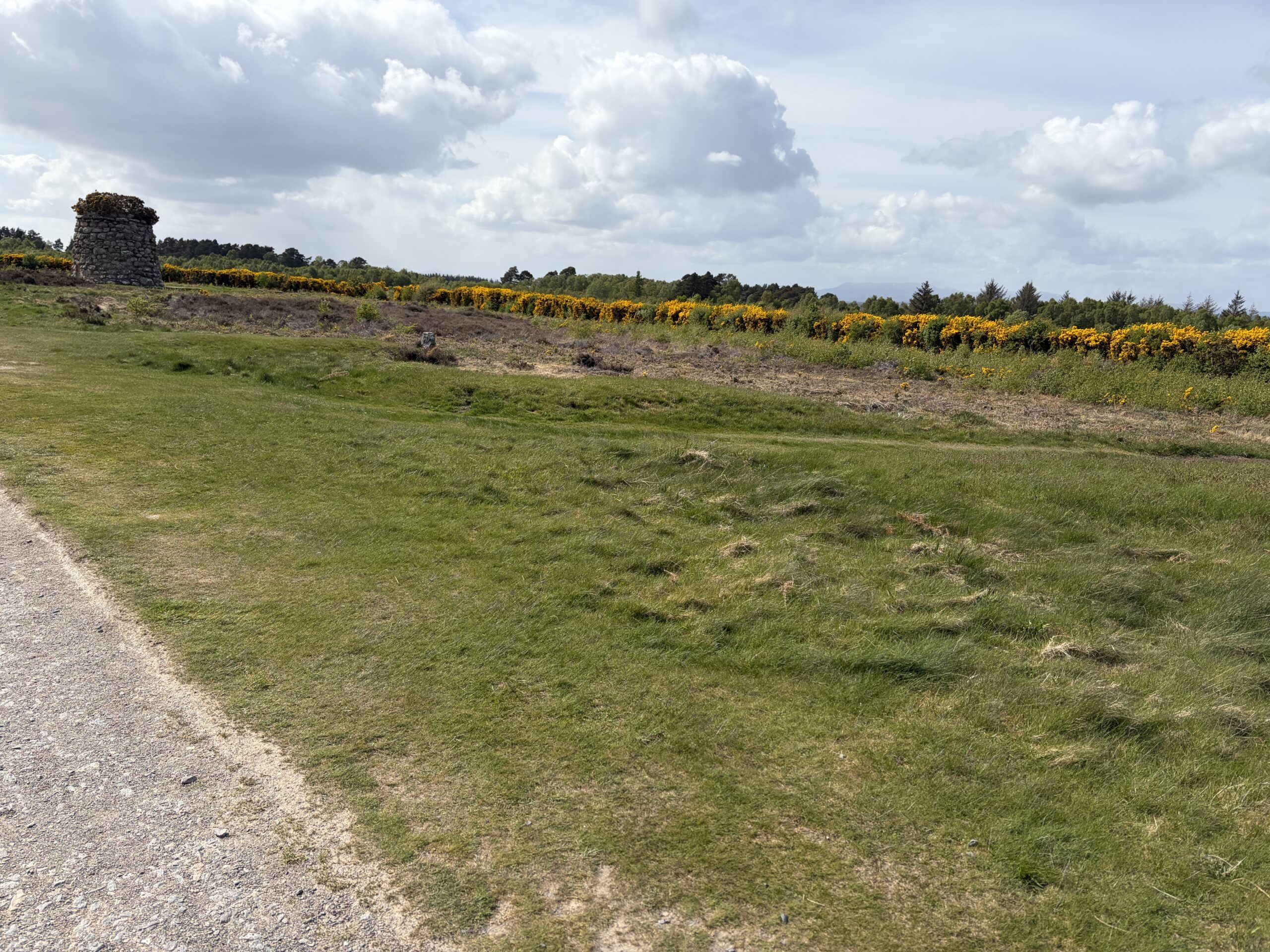
Like many important battlefields in America, the battlefield at Culloden is only part of where the fighting and dying happened. (Antietam and Gettysburg are the exceptions.) That the core acreage is reverently preserved and evocative is an achievement of which the Scottish National Trust can be proud.
The field is still cleared of sight-limiting vegetation, as it was on April 17, 1746, although the fringes, where fighting also occurred, are taken up by 5th and 6th-growth trees, and in some places, “holiday houses.”
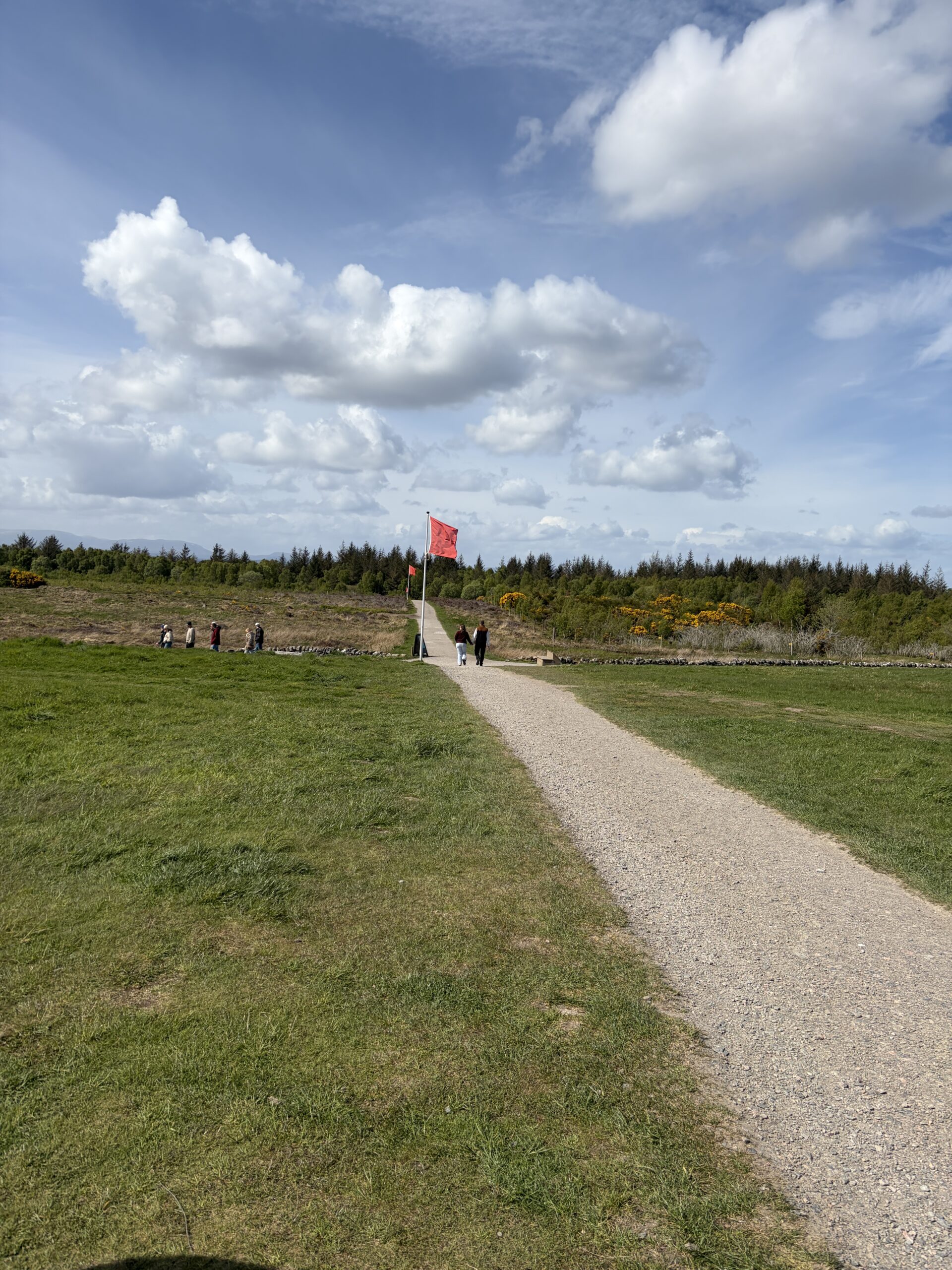
Red flags mark the government (Duke of Cumberland) front line, blue flags the Jacobite (Bonnie Prince Charlie) line.
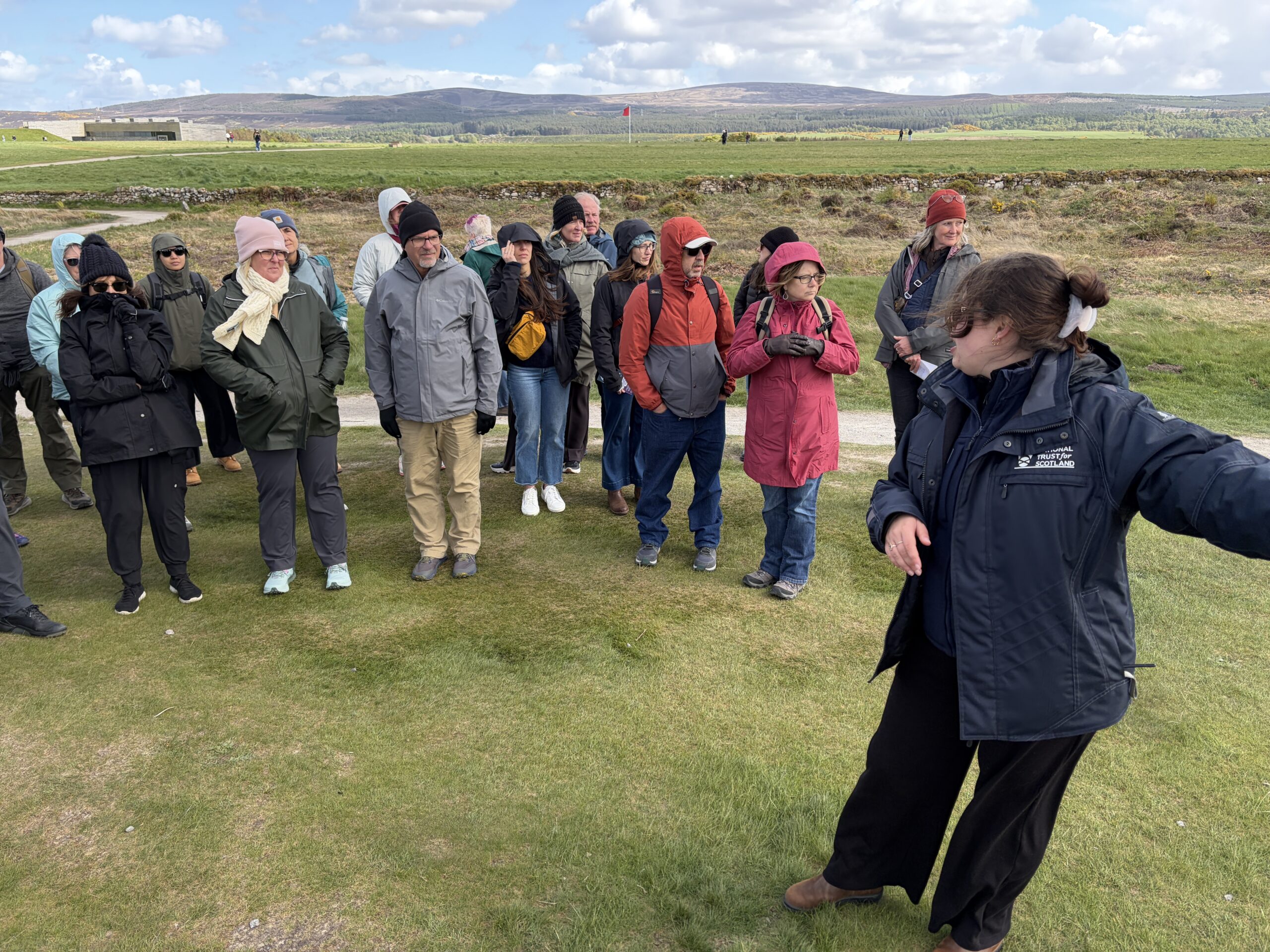
You could pay 5 pounds for a tour, and it was worth it. Our guide, a woman named Charlotte, was well informed and efficient. Her first big point was this wasn’t a battle between Scotland and England.
It was a battle over two royal houses–the Hanoverians, who were on the British throne, and the Stuarts, who’d been ousted and were the “pretenders.” The Stuarts were of Scottish descent and had a large following among the clan-based people of the Highlands.
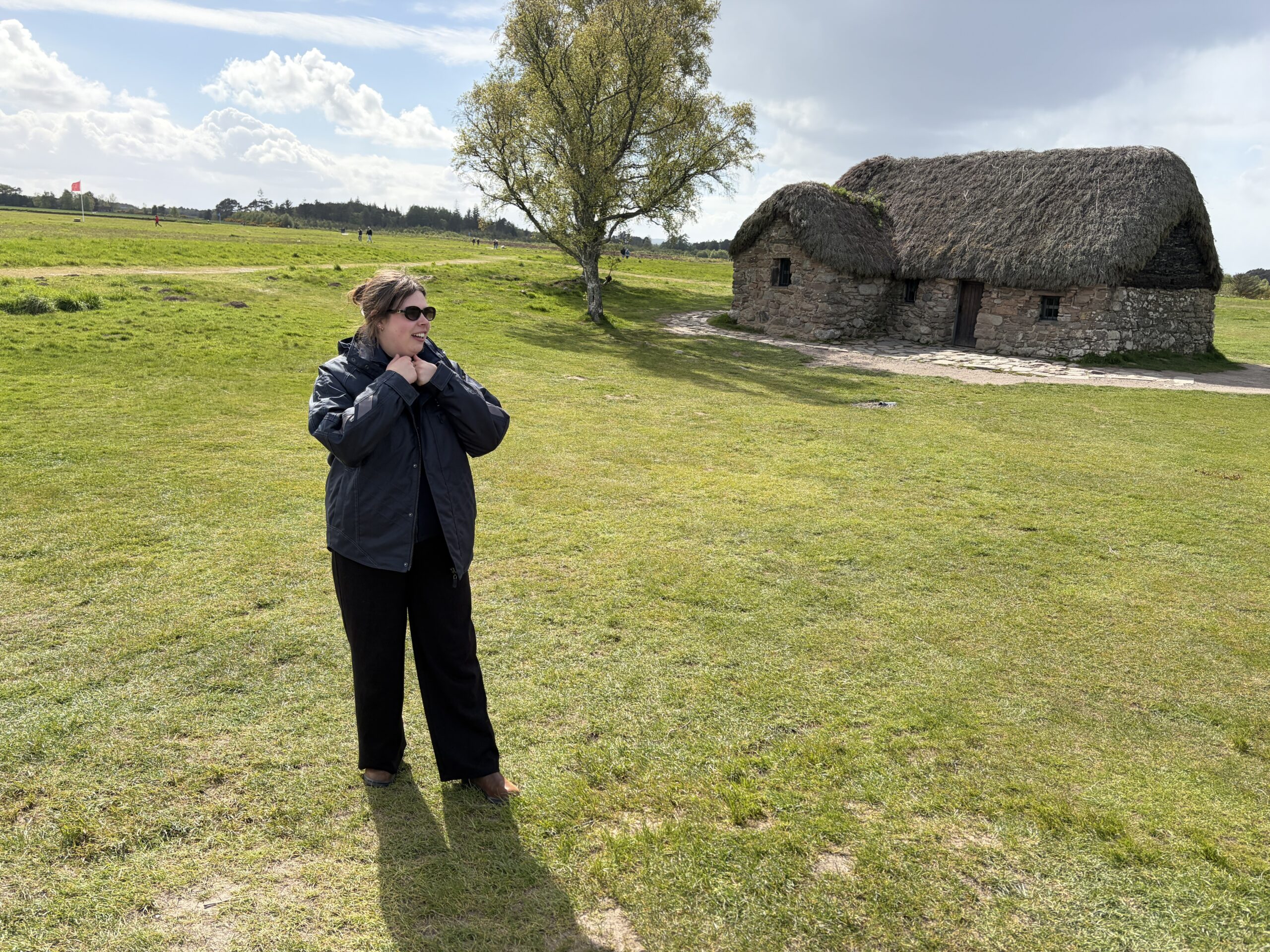
She said tour would take 45 minutes–“about the length of the battle.” It was cool and breezy, as you can tell from her listeners’ dress.
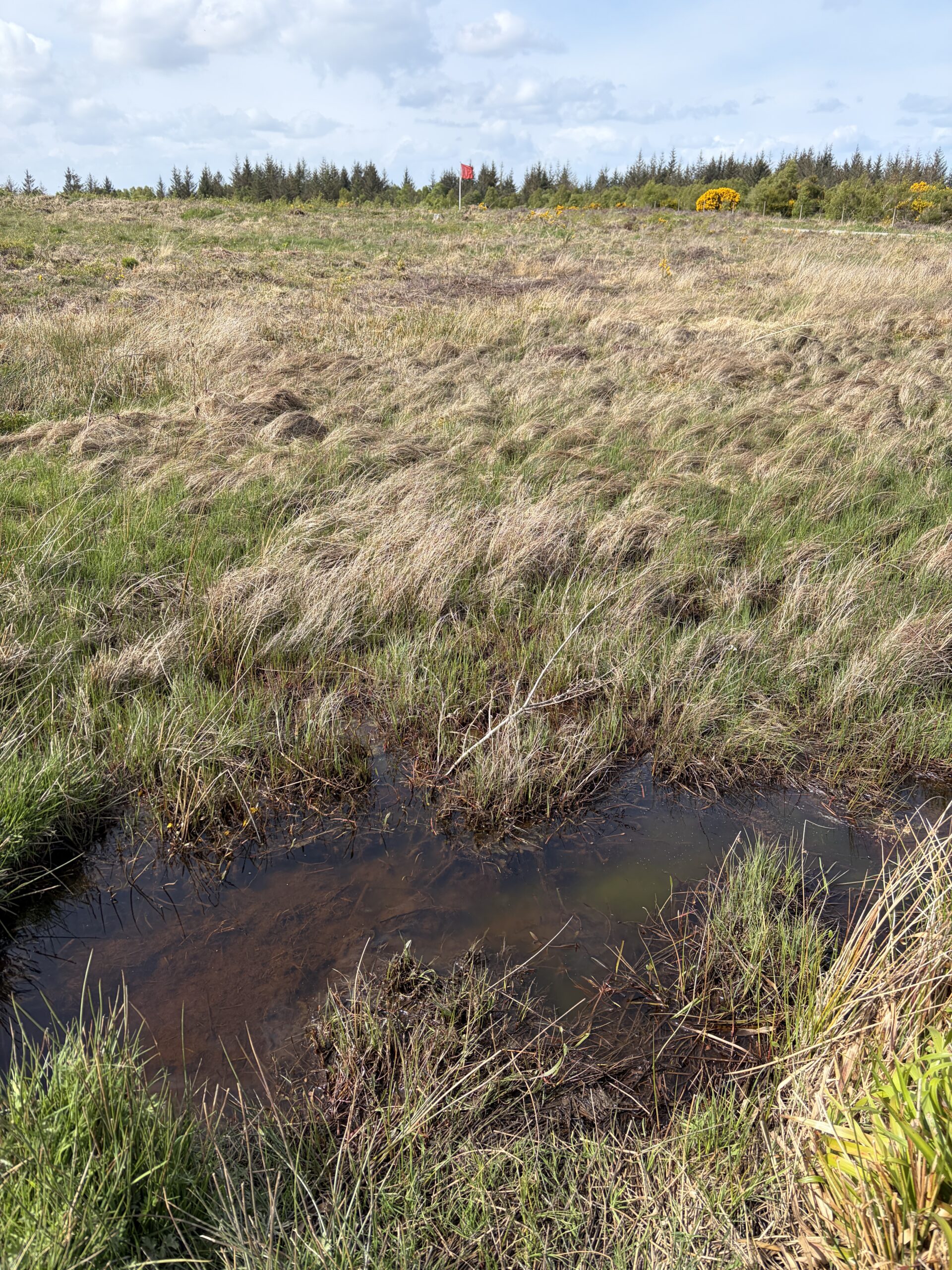
All accounts of the battle say that part of was held on a “boggy moor.” Some of that remains. The water and mud slowed a Jacobite charge, making the soldiers easy targets for musket fire and grapeshot.
The Duke of Cumberland, who had just turned 25, sealed off the battlefield, gave his troops an order “to show no quarter.” The wounded died or were killed.
Several days later he went to Inverness, rounded up some Jacobite sympathizers, and brought them to Culloden to bury the Jacobite dead. About a dozen mass graves were dug. You can still see slight humps in the ground where they are. Charlotte said they’ve never been opened for archaeological or other purposes.
In the Victorian resurgence of Scottish clan pride, an aristocrat named Duncan Forbes put stones with clan names at the head of the graves. But in truth, nobody knows the identity of their occupants. Many are Irish, French, and English, as Jacobitism had international support.
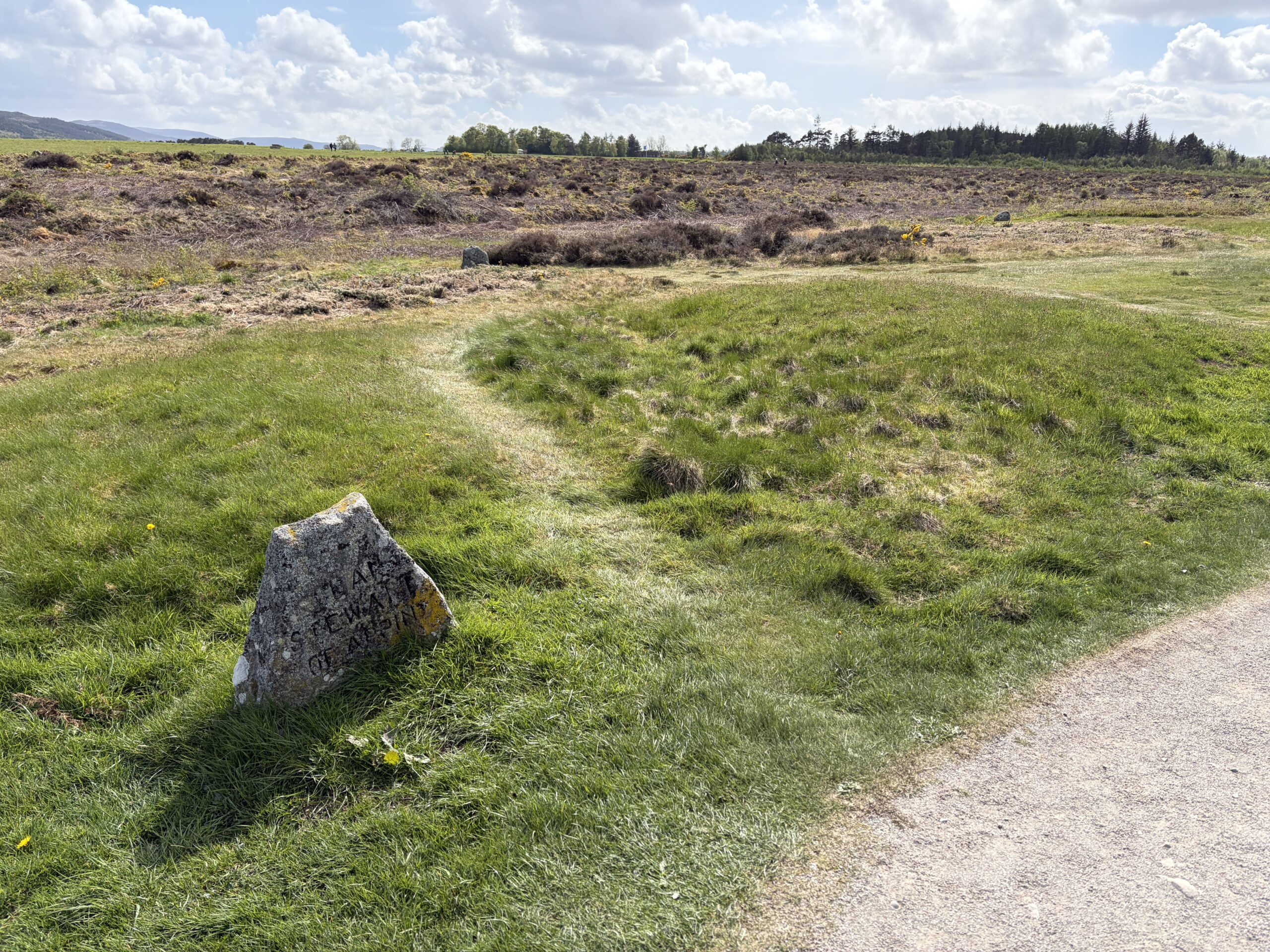
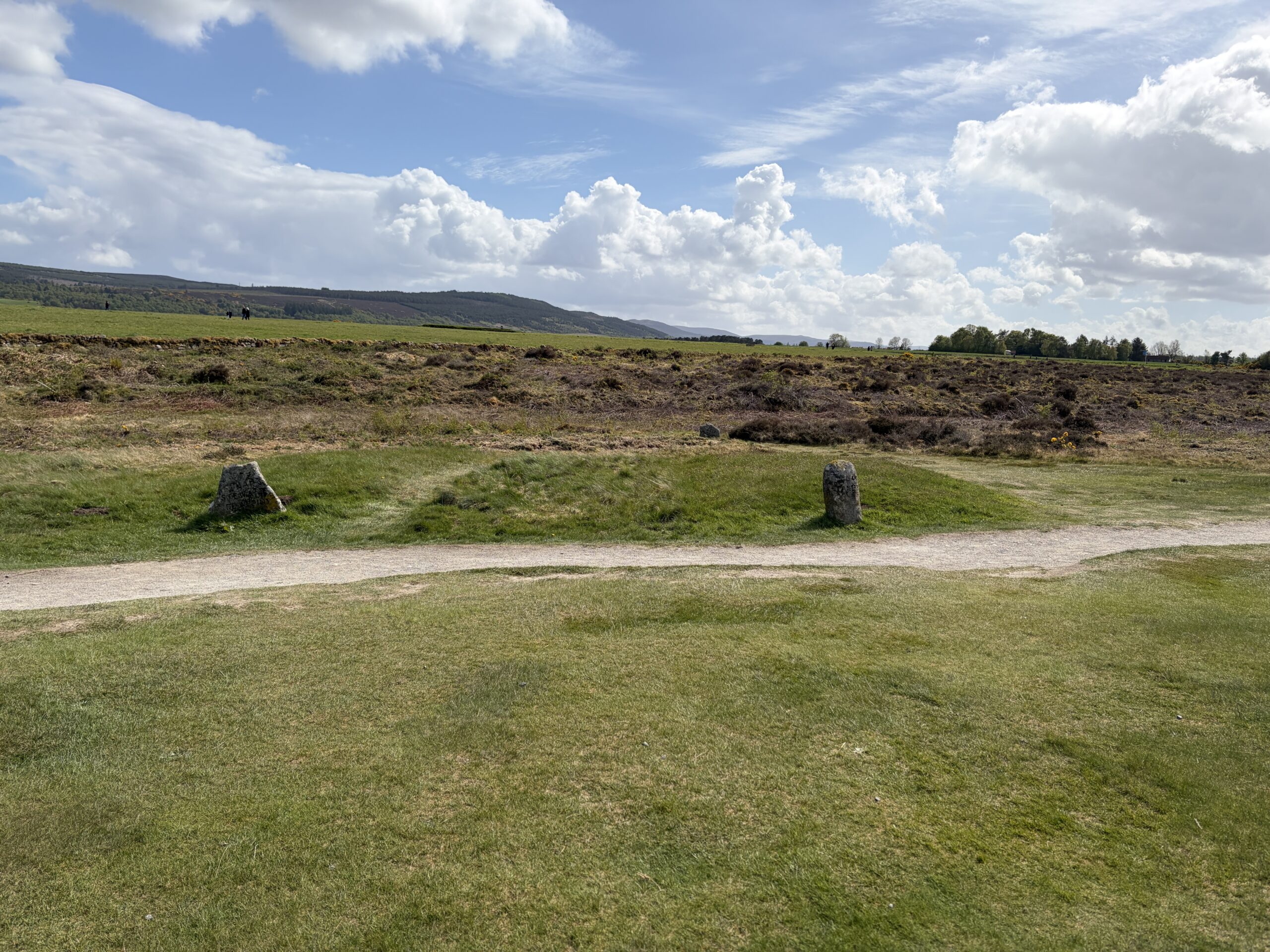
Behind the government lines was a stone cottage with a thatched roof. Like the Dunkard Church on the Antietam battlefield, it is often described as the only surviving architectural witness to the battle. But Charlotte said it had undergone several rebuilds since 1746, and at most contains only some stones from the original structure. It was occupied until 1911; the people who lived in it were the first battlefield tour guides.
The official death toll was 50 government dead and 1,500 Jacobite dead. The numbers are imprecise; in particular there were probably more 50 of the Duke’s soldiers killed.
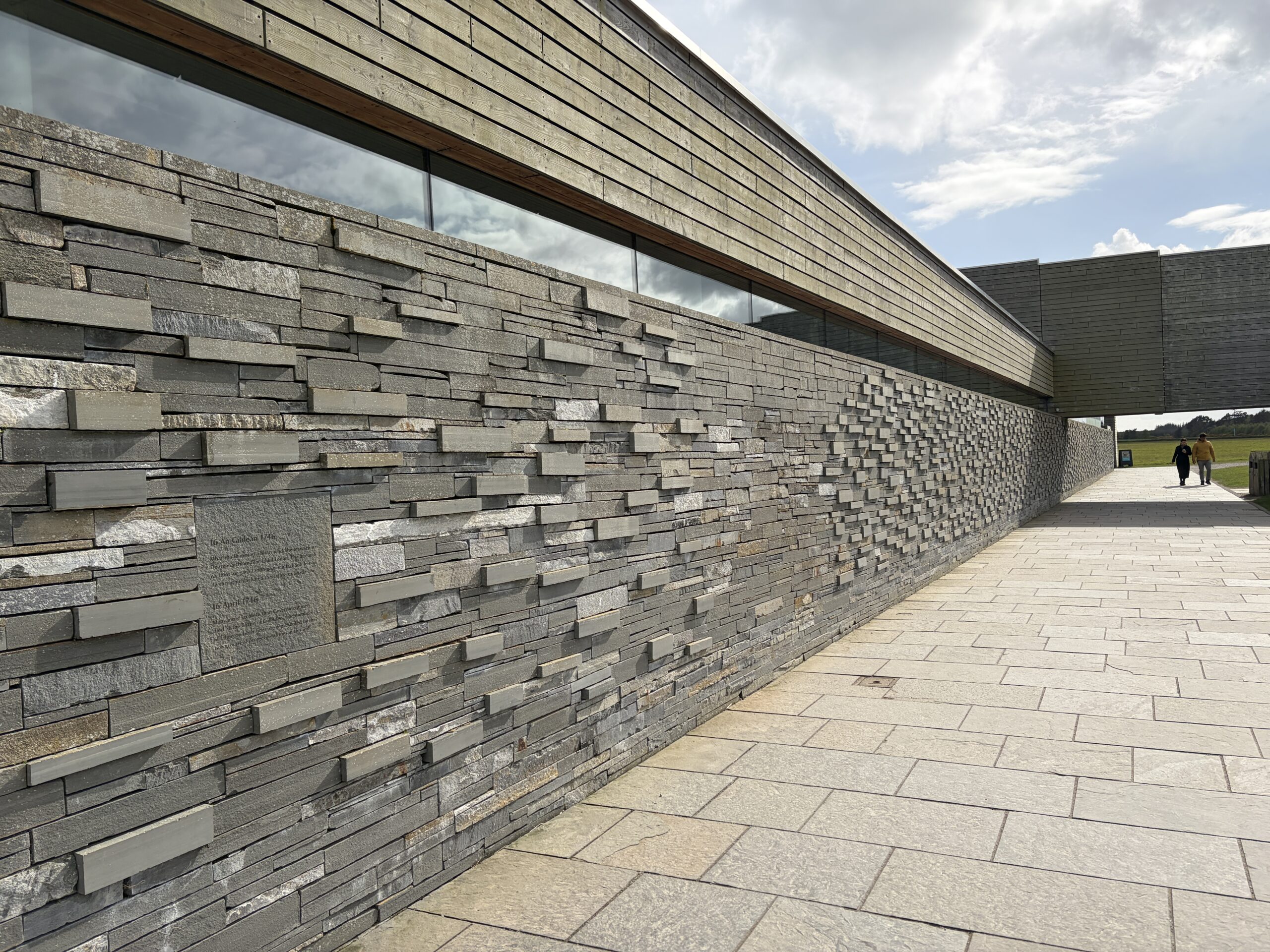
Nevertheless, there’s no question it was a Jacobite rout, and slaughter. At the visitor center there is a wall that has a raised stone for each of the “official” dead–the government on the left, the Jacobite in the distance on the right. It’s a moving linear tribute, a bit like the Vietnam War Memorial in Washington, and the Flight 93 Monument in Shanksville, Pennsylvania.
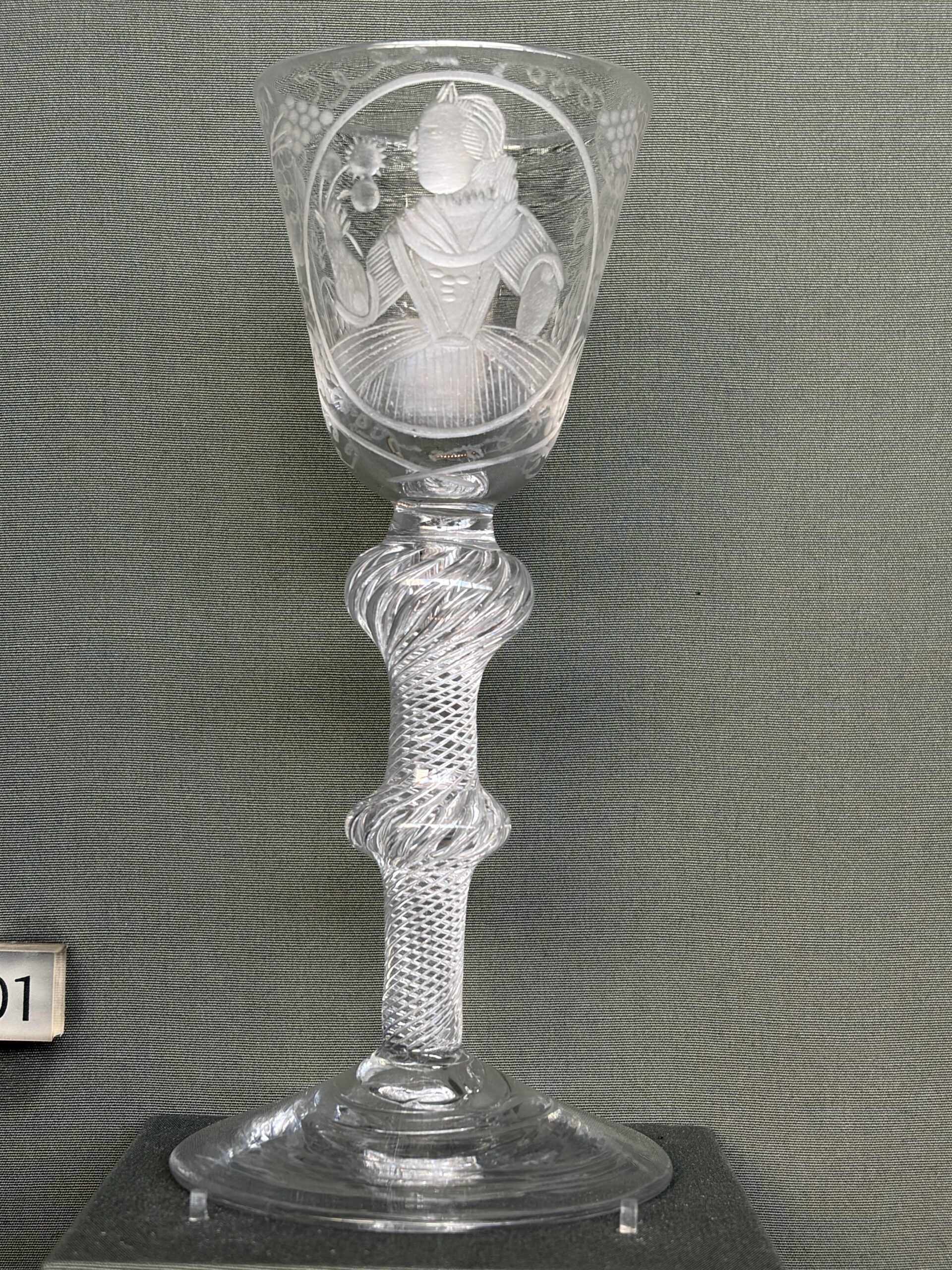
There are few material artifacts from the battle, mostly musket balls and scraps of metal. There’s a robust collection of post-Culloden knickknacks. One is this etched goblet that shows Bonnie Prince Charlie dressed in drag as the maid of a Highland woman named Flora Macdonald, who helped him escape west to a Hebridean island, where he was picked up and brought back to France.
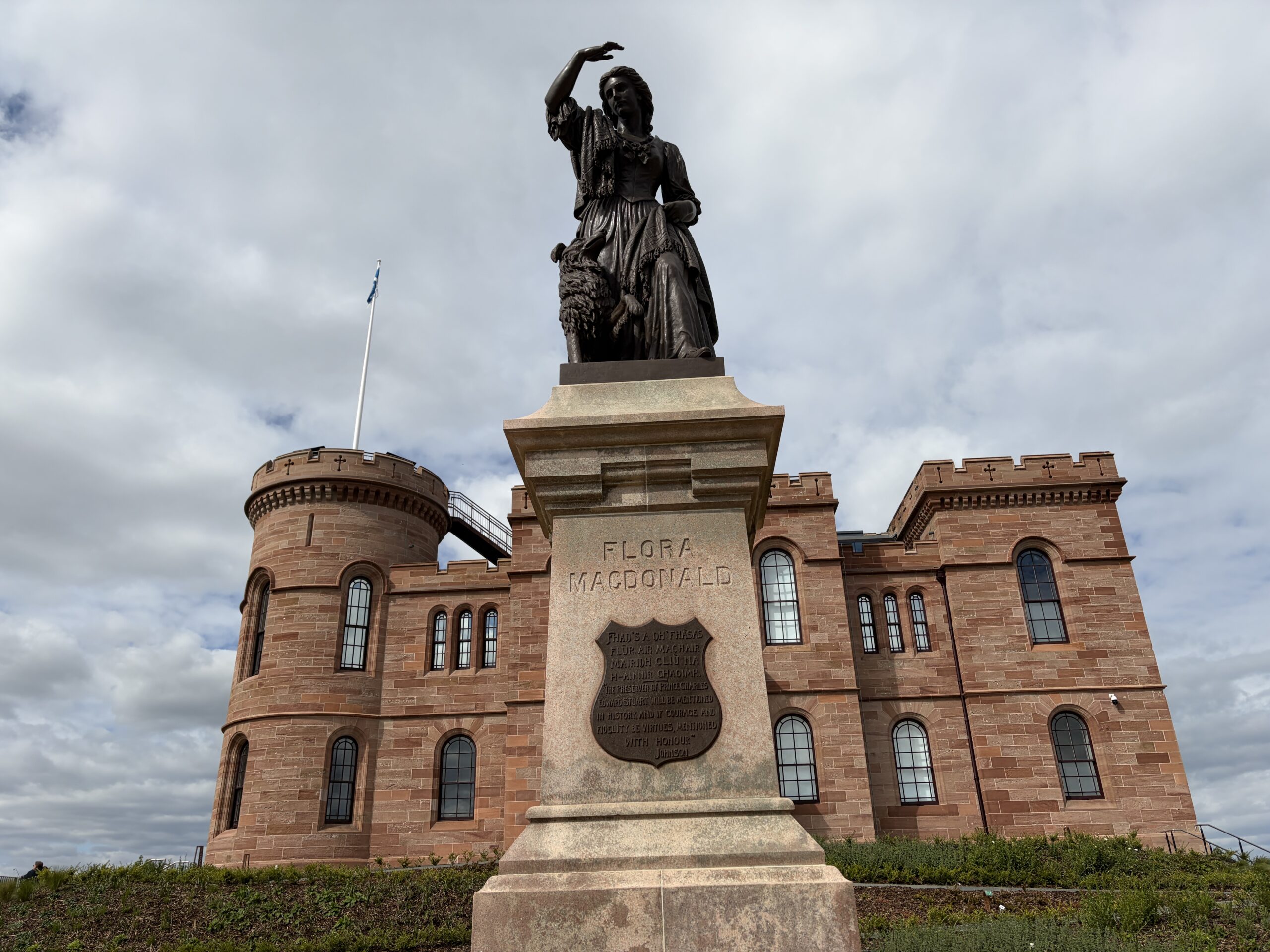
Flora Macdonald is more of a hero than the prince. Her statue stands in front of Inverness Castle, a symbol of Scottish resistance and ingenuity more than of anything that might have been achieved by the strange and failed cause of Jacobitism.
Recent Comments