A wee walk

A blog about a hike across Scotland (and possibly other things)

Page 15 of 16

Proper knackered

Invergarry Hotel was only halfway to that’s day destination–Fort Augustus and a bed.  The whole day was close to 20 miles, a lot of it on road, which I am beginning to realize is much less pleasant than walking on almost anything else.  On the feet, that is.

I got to the Bridge of Oich, which has an unusual suspension design that allows it to remain standing even if some of the cables break.  It was designed by a brewer turned engineer in the mid-19th Century.

image

On the river there was a fisherman.

image

Here, the route turned northeast along the Caledonian Canal that goes up to Loch Ness at Fort Augustus.  It was raining lightly and I was very tired when I arrived in the village.  I remembered that the B&B where I was booked was a half mile out of town.  The phone was busy for about a half hour so I walked.

Reladen with a food package delivered to the B&B, I headed off as heavy as ever the next morning.  The route when a short distance on the paved road, then onto a dirt road along fields and farms before coming out onto another paved road.  There are beautiful stone walls here, architected with round and flat rocks in courses, not just piled like the ones in New England.

image

I took a turn at a path in a break in the wall that turned out to be a few hundred yards short of the one I should have taken.  It led through the woods onto a dirt road that eventually opened into a clearing with a new house, a statue of a buck and some farm machinery.  A road went up under an old stone bridge to the right; the map suggested I could regain the route there.

As I was approaching the bridge a pickup truck drove up and the man asked if he could help me.  I told him I was on the TGO Challenge, just passing through.  He told me I was on private property and shouldn’t be there.  I told him I was under the impression that one could walk across private property in Scotland.  He said that was wrong.  You can walk on private land in the hills but not near houses.  He said his boss was an American, and that as an American I should know not to be trespassing.

I apologized, he directed me to the road I wanted and I headed on.  Very soon after, the route I’d charted had me opening a gate and going within view of an even bigger house, a pink castle surrounded by scaffolding.

image

I decided against doing that and continued up the gravel road I was on.  It climbed up some bare hills, then across the tops.  I took a path down to a stream and scrambled up a muddy cow path on a very steep slope to what I was trying to reach, something called on the map “General Wade’s Military Road.”  It was built in response to the Jacobite Rising in the early 1700s.  I know nothing more about it than that.  And I hope personally not to see it again anytime soon.

The views were beautiful and after four days in a timeless landscape, strangely modern.  A power line went over the hills the whole route, and a second one was being built.  Work crews were using heavy machinery building the pads for the towers.  The construction sounds carried a long distance.

The road was rocky.  There was the occasional stone bridge and ruin.  The road climbed relentlessly.  Every corner where I thought it would finally level out revealed another climb.  I obviously hadn’t spent much time looking at the contour lines on the map.  It turns out I was going over something called Corrieyairack Pass.

image

I finally got to the top and headed down, which was less tiring but no less painful on the feet.  When the crews knocked off at 5 they came down the road in two green ATVs.  The second one stopped and offered me a ride.  I was tempted, thanked them, but told them I couldn’t.  Not allowed in the Challenge.

The shadows were very long, it was getting cool and it was after 8 when I arrived at Garva Bridge  for the night.  It was about 18 miles.  I was completely exhausted, or as they say over here, “proper knackered.”

Signs


Death and remembrance never take a break, even in the middle of nowhere.

image

Be warned, people and dogs.

image


Avoiding the rare trout-fishing fatality.

image

The Scrabble set in Scotland is different.

image

Would we expect anything less?

image

Seems more like Spey Fish Hell.

image

Future foretold.

image

Onward

It was sunny when we left Kinbreack bothy.  Jim Taylor left before us; the tents outside were long gone.

We climbed a while, then descended on the north side of the River Kingie. We entered the woods and it started to rain lightly.  The trees are all planted and so close together it would be impossible to get through them without a path. We were on dirt road–two ruts and a grassy hump in the middle.  We passed Jim Taylor in the woods.

We continued on many miles to Hotel Tomdoun, a hostelry whose closure several years ago is much regretted by many Challengers. It is on a hillside with a great open view of the river and the glen. There was still some furniture inside. An official notice on the door said that people with property inside should collect it by a date in January of this year.

My original plan was to camp on the hotel lawn (or “garden” as they say here), but I was worried about the 18-20 mile day coming up so decided to go a mile or so farther.  Alan said there was a flat spot near a bridge ahead where he’d seen people camping. They were going on about five miles to keep on plan, although Colin did not seem wild about the idea.

I did find an acceptable spot in the floodplain at the foot of the bridge near a pile of brush and a fire ring.  I felt a little sorry to see them go on.  But the Challenge is for solitude and chance encounters, so I didn’t want to attach myself to any group too much.

This turned out to be a good choice, as the next morning–a clear one, although I believe it had rained a little overnight–I looked up and saw Jim standing on the road above, about to cross the bridge.

I asked him if he wanted some tea, and to my surprise he accepted. I had just filled my thermos (a hopeless indulgence in the eyes of many fellow walkers) so I came right up.

He sat down on his pack and I reintroduced myself. He seemed in a far more talkative mood than the night I had met him. He’d spent the night on the hotel grounds. He mentioned stopping at a farm at some point to talk to people there; he said he had a kinship with farmers.  And that got us started.

I had the presence of mind to pull out my phone and start videotaping.  I wasn’t sure the sound would be audible, but it was fine. You can even hear the ducks and seagulls flying overhead. I interviewed him for 24 minutes.  But unfortunately I can’t find a way to put any of the video on this site.  The previous post is the highlights of it.

He moved on and I had breakfast and broke camp.

The walk was bucolic and agricultural.  I passed lots of fields with ewes and lambs, houses and farm buildings but, surprisingly, no farmers and residents. I did, however, meet Alistair (or perhaps its Alisdair), an Englishman who was walking alone. After a while we overtook Jim Taylor. He was taking a break. I took one too and Alistair moved on.

We were entering a forestry preserve where long-haired, long-horned Caledonian cattle roamed freely, part of a plan to restore the land, at least somewhat, to its primordial state where large herbivores browsed the undergrowth and kept everything in balance. I took off alone and soon encountered a herd of them, about half standing or lying on the road.  They looked like what I imagined aurochs looked like.

image


It was hard to guess how aggressive they might be.  But they didn’t move as I approached, so ceded them the road, getting one foot wet jumping over a little stream onto a boggy bank.  Going up the hill I looked back and saw Jim walking right by them.

image

I was actually off course, having crossed the foot of Loch Garry onto the south shore instead of proceeding on the north. What I took was the way the traffic was going (namely Jim and the person who passed us) and was, in any case, less of a thoroughfare than the north shore.

I trudged on down a hard unpaved road, flat, not very interesting but painful on the feet. Much of it was through eighth-growth woods. I finally got to a place where I thought I was going to have to go onto the paved road. But then I noticed a path parallel to both the road and a stream.

I took it and it was delightful, reminiscent of the lower-elevation parts of the Long Trail in Vermont, lots of moss-covered hardwoods and a few flowering plants along the path. There were many trees with big burls.

image


image

I passed two women and a dog and eventually came to a section where one could look up and see back yards. I climbed up to the road very close to where I had hoped–Invergarry Hotel. I cooked up (after a fashion) my lunch of pasta carbonara and had a pint from the bar, both earned, I thought.

image

Jim Taylor’s story

What follows is partly from the conversation in the bothy but mostly from a more extended conversation two days later.  The exact circumstances you’ll hear in another post.  But in the interest of continuity with the last one, I am recounting Jim’s story here.

image

Jim Taylor, who will be 92 in September and is walking across Scotland as I write, left school at age 13 1/2. This required an exemption. Why he wanted it–and why his parents allowed it–I don’t know, but hope to find out. In any case, he was in the top group of students.

He went to work at a farm in Aberdeenshire. He remembered all the farms where he worked by name. He was an agricultural horseman until he joined the Royal Air Force in December, 1940.

This first farm was a small one called Pleidy, with one pair of horses.  Jim was an apprentice, in charge of one horse. He was paid eight pounds for a six-month term, the contract sealed with a shilling payment to the laborer from the farmer. This was in 1935.

After six months, he went to another farm that also  had only one pair of horses. After that to another, Cairn Andrew, whose farmer was a Mr. Robb, where he was a second horseman, in charge of a team.   One of the bigger places where he worked was called Strocherie. There were three teams of horses, each with a horseman. There was a also handyman, a beef cattleman, a dairy cattleman, two parttime gardeners, a greve (the overseer) and two women in the house. Strocherie also had a tractor, the only one in the district. The farmer was a Captain Barclay, a retired Army officer, a bachelor.

He eventually became a first horseman. Everything was done by horse—plowing, carting turnips, hauling muck.  His top wage was 40 pounds a term.

The horsemen got up at 5.30 in the morning, fed and watered the horses (which were Clydesdales), ate breakfast and were in the fields by 6.30.

The crop rotation was a “seven shift system,” he said. There were three years of grass, with  cattle grazing on it. Then a crop of oats, a second crop of oats, then a crop of turnips, then grass with a crop of hay cut. Then back to grass for three years. The turnips were winter feed for the animals.

The food for the workers was hardly more variable.

For breakfast they had rolled oats with boiling water poured on it and mixed, and salt, pepper and milk added. There was never meat at breakfast. Dinner was at noon, sometimes mincepot, sometimes just potatoes and turnips mashed together. Supper was oatcakes, stale bread soaked in milk, or more porridge. There were never fresh vegetables, he said, and only fruit if you went into the village and bought it with your own money.

When war broke out, Jim tried to join the Army. But farm work was a “reserved occupation” and farm laborers were not allowed to enlist because food production was so important. He was turned down.

“‘Oh, no, we can’t take you’, the Army recruiter said. ” ‘We get into trouble if we take people off the land’.”

So he went next door to the Navy, thinking things might be different. But they weren’t.

“‘No, we can’t take people off the land. We’re having to send them back again’.”

A week later the recruiter for the Royal Air Force came to the labor exchange.  Jim went to see him.

“He asked me, ‘What do you do?’ and I told him, ‘I’m unemployed’.”

He said that he’d been working on a rural electrification crew, but it had moved on and he’d stayed near home.  This, of course, was a lie.  The recruiter gave him some easy arithmetic to do; Jim thinks it was adding fractions.  He passed.  The recruiter told him he’d let him know the decision.

As Jim was walking to the door, the recruiter looked at him and asked: “Now wait a minute. Are you sure you never worked on a farm?’

”He must have seen my gait, the plowman’s gait,” Jim said, remembering the moment.  To the recruiter he said:  “Oh, no no no.”

“Right-o. You’ll hear from us in a couple of weeks.”

Two weeks later he was in.

It was the easy life compared to what he’d seen.  Soon he’d put on weight and could no longer fasten the top button of the two dress shirts he’d been issued.  He went to the supply clerk to get replacements.  He was told he couldn’t get any.

“Those are perfectly good shirts,” the man said.

“But I can’t button the collar,” Jim said.

“Well, you’ll have to go to the doctor and get a chit for a new shirt.”

Everyone who went to sick call had to be prepared to be admitted to the hospital, so Jim packed a kit with his razor, toothbrush and other toiletries.  People on sick call also had to be examined by the medical officer in the nude.  But Jim left his shirt on because he wanted to show how tight the collar was.

“No, no.  Strip off,” the sergeant said.

“But I’m going to get a new shirt,” Jim said.

“You can’t go in like that.  Take it off,” the sergeant said.

The doctor came into the examination room and said:  “What can I do for you, young man?”

“I’m here to get a chit for a new shirt,” Jim said.

Whaaaat?” the doctor said.  “I’m a bloody doctor, not a draper!”  He turned to the orderly and mumbled, “Okay give him a chit.”

Jim pointed out that his other shirt was returning from the laundry the next week and he would need a chit to replace that one, too.

“Well, we’ll cross that bridge when we come to it,” the doctor said.

“So the next week,” Jim recalled, “I went through the whole procedure all over again.”

After basic training he became an airframe mechanic, responsible for the pneumatics, hydraulics, tires, controls—everything but the engine—on airplanes. He worked at a base on the northeast coast of Scotland, from which American crews left to bomb German installations in Scandinavia.

He was eventually sent to Nova Scotia, where British airmen trained. He worked on the Mosquito, the famed wooden fighter-bomber. For a time, the plans and specs for it were classified, but the head of maintenance broke the rules and let the airframe crew look at them.

He was in 5 1/2 years. When the war was over, he did not go back to farming.

“I became a welder.”

He had many jobs. When he was required to retire at age 65, he got a job helping make barrels with a cooper who had a contract with a distillery. He retired for good just before he turned 75.

He has been a hillwalker all his life.

His wife died 14 years ago this month. He cancelled his plans to go in the Challenge that year because she was ill. She died during the event.  After the funeral, there were a few days of the Challenge left.  So he drove up and walked the end.


Here is video of Jim telling his shirt story.


Day 2, part 2

I don’t know any geology, but I intuit that the Highlands’ glens and lochs were made by either violent seaward migration of glaciers or violent melting of them.  In any case, something carved linear vees into the land.  The lochs are more like fjords than North American lakes.  And in the rivers and burns–the name here for streams–the water runs ceaselessly.

image

For this day and all the first four it was impossible to put a foot down on a surface that was not just wet but saturated.  Super-saturated–the water pooling–in most cases.

We went up a ridge over Finiskaig River, where for a way there was a vertical drop to the right, one slip and it would have been over.  And it was already over for some of the previous travelers.

image

The trail leveled out as we entered Glen Dessarry, and the sun came out briefly too.  We were on a trail, which helped.  Then it was up over a pass and another watershed, the river on the other side flowing in the opposite direction from the one we’d been walking beside.

The ground was sphagnum moss on top of peat. which is sphagnum moss from eons past.  It was  boggy, lacking only the eye and underwater pond of a true bog.  It seemed impossible there could be such a thing on a 10-percent grade.  In places, the water appeared stopped, a gelid mass flowing but not moving.

image

When we got to the top of the pass it started to rain again.  There was still a fair way to go to Kinbreack Bothy, which is the building with the red roof in the distance.  It was a slog, everything getting heavier and the ground squelchier, as they say over here.

image

When we got to the bothy, Alan went inside and found to his surprise there was no one there.  Two tents were pitched about a hundred yards down the burn, undoubtedly when the sun was still out.  The burn itself was a  bit sketchy to cross.  I stumbled stepping from rock to rock; didn’t fall, but the tip of my trekking pole caught under a rock and cracked.

The bothy had been rehabilitated but still emanated the mysterious presence of previous inhabitants.  The downstairs was floored with rough cobbles from the stream, the place for the animals, with a room next to make use of the warmth from them (and provide some besides).  Up a new staircase was a single room with fireplace at one end.  There was a little wood, a long bench on each side for sitting and sleeping, and some emergency cans of beans on the mantel piece.

image

We settled in, Alan lit a fire, we hung up our socks in a vain attempt to dry them, and ate.  It finally got dark.  It was raining hard and we were very happy to be there and nowhere else. And then to our surprised we heard someone clumping up the stairs in the gloom at the other end of the room.

A man appeared and put down a pack.  He started taking off his drenched clothes and Alan exchanged a few sentences with him that I couldn’t understand.  But it became clear soon that the man had fallen into a burn–a stream–and rolled over, getting everything wet.  Whether it was the stream right outside the house wasn’t clear, although I suspect it was because the last one we’d had to ford was quite a way back.

The man spoke in a very low voice, moved slowly and was obviously not young.  He was, in fact, unsteady as the took things out of his pack and hung them up.  he then went over to a detached bench of take off his clothes.  Alan commented that he seemed a bit hypothermic.

I went over and asked him if he wanted a cup of tea.  Both Colin and I had our stoves out and running.

“No, thank you, I’ll just drink water.”

His accent was very thick.  Thinking perhaps he forswore stimulating beverages, I asked him if he wanted a hot meal.

“No.  I haven’t carried a stove for three or for years.  I eat only cold food.”

“Well maybe when you fall in the burn it’s the night to make an exception,” I suggested.

“I’ve fallen in a burn before.”

Okay.

After a while he walked over.  He had changed into drier clothes and a pair of new blue tennis sneakers.   Alan got up and invited him down next to the fire.  The man pulled out a bun filled with cheese encased in plastic wrap.  It was the only thing he ate.

image

Conversation began and someone asked him how many times he’d done the Challenge.  He said this would be his 20th.  Alan asked him is name.

“Jim Taylor,” he said.

“Jim Taylor.  We’ve met before.  A couple of years ago at Tarfside.”

Jim Taylor was a 91-year-old man, mentioned in the event newsletter, who was not only this year’s oldest walker but would set the record for the oldest crossing if he finished.

Earlier in the day, Alan had told the story of meeting him at Tarfside several years ago.  Tarfside is a choke-point on the hike a couple of days walk from the east coast where there are sometimes a hundred or more Challengers.

Jim Taylor was famous for fast crossings and that year had finished two days early.  Someone had driven him back to Tarfside to socialize.  At some point he met Alan, who mentioned in conversation that in 1999 he’d walked partway with Jack Griffiths, who held the record as the oldest crosser.

Jim Taylor, who was 89 at the time, was under the impression Griffiths had been 93 at the time, and commented that he thought he’d never catch him.  But Alan assured him that Griffiths was only 90 at that crossing, his last.

“You could see the expression on his face change as soon as I said that,” Alan had recalled.

It turns out everyone on this year’s walk has heard of Jim Taylor, admires him from a distance, and hopes to meet him.  And here he was in a bothy with us.

He did finally accept a “wee dram” of whisky from Alan’s stash and began to talk a bit about his life.  You’ll hear more about that later.

The rain continued.  At some point Alan went out to get water from the stream.  He took my bottle and  Colin’s too.  When he returned he said the water had risen dramatically.

“I don’t believe we could cross that burn now,” he said.


Predictably . . .

I’ve had a major computer disaster.  IPad mini is disabled for unknown reasons , possibly because it was left on in the pack and jostling a simulated password attempts. Many posts waiting to be written or uploaded at wifi equipped towns. Possible disaster.  Please stand by.

Alan and Colin

Colin, who is 44, doesn’t want me to go into what he does or where he works because of sensitivities of his employer. But it’s perfectly honorable work.

Alan, who is 70, is willing to let me tell a bit of his story. I queried him about his family history, Scottish history, Knoydart demography, the Clearances, all sorts of things. He was a hillwalker par excellence. He has finished “the Munros,” which is the name for all the hills in Scotland over 3,000 feet. There are 282 of them, catalogued by and named after a man named Hugh Munro. He is almost finished with “the Corbetts,” which are hills between 2500 and 3,000 feet.  He’s gone trekking at 18,000 feet in Nepal, and in Moab, Utah, and many places in between.

We talked about how people survived out here 200, 300 years ago. He told me about crofters, the tenant farmers,  and lairds, the owners of the land.

Crofters grew vegetables, oats and barley on ground in which the soil, full of rocks, had been piled up in elevated furrows–the original raised-bed gardening. Cattle was a cash crop, and there were cattle drives out of the Highlands south to market. Rob Roy, an outlaw hero villain, ran a protection racket in which people paid to not have their cattle rustled on the way, according to Alan. You know the Chisolm Trail from Texas to Kansas? The father of Jesse Chisolm, for whom it was named, was a drover in the Scottish Highlands, Alan said.

Alan came from MacDonalds on both sides of his family.  They lived in a place called Glen Moidart before the Clearances, and then were forced to a place on the coast called Smirisary, a settlement of 15 to 20 buildings that still exists without a paved road.  One of his great grandmothers on his mother’s father’s side came down to Glasgow.  She never learned English, although her son had forgotten Gaelic by the time Alan knew him.

Alan used to go back to the Highlands for summer vacation, put on a train in Glasgow with his name and destination pinned to his jumper when he was as young as six.  From the train terminus he had to walk a mile to a ferry.  Somebody always looked after him, he said, and he doesn’t remember being afraid.

At one point I apologized, as a formality, for asking so many questions.

“I’m a journalist, so I made my living asking questions.”

“Well that’s good,” Colin said, “because he was a tour guide.”

Before that he’d been a sales representative for a tobacco company and an executive of the Youth Hostel Association.  For about five years before retiring he had a business in which he took clients on five-day car trips around Scotland,  narrating as he went.

I asked him if he’d been to Priesthill.   I said I had an ancestor who’d been martyred there, killed by a man named John Graham of Claverhouse.

“Oh, Claverhouse.  The story in my wife’s family is she is descended from a man killed by him, John Brown.  Shot him in front of his family.”

This, of course, was the John Brown who is one of my mother’s ancestors.

I asked him if he’d been out to the monument at Brown’s grave.  He said he had; his wife had wanted to see it.

“It’s way out on a moor.  If you go, bring a brush, as it’s mossy and hard to read.”

I turned to Colin and said,  “Well, I guess that makes us kin.”

“No, I’m afraid not,” he said.  “It’s his second wife.”


Alan Mitchell

Alan Mitchell

Colin Mitchell

Colin Mitchell


Day 2, part 1

It was raining when I woke up, which was several hours before I got up. I had breakfast, the cooked-in-the-pouch porridge and coffee, with extra made for the thermos (which just made the cut at send-back time).

But before breakfast: three aspirin.

I managed to eat without spilling, the bottom half of my body in the sleeping bag, and then dress and pack everything inside the tent. Everything but the tent, of course. By the time it was time to pack it, the rain had stopped.

There was a “bothy” at this spot. A bothy is an old building that has been repurposed as accommodation for hikers. It is usually an old stone homestead; sometimes it is a former “beya,” or place for animals.

Most bothies (I am told) have room for six or eight comfortably, but in bad weather hold 16 or 18. I have know idea how many people had stayed in this one. When I arrived at the camping area (which a man named Mark, who I walked the last hour with, described as “about the size of a baseball pitch”) I went by the bothy to take a look. One man was eating and another one was talking to him. Across the pitch 14 tents were pitched.

This was all at the head of a “sea loch,” which is to say a long bay in from the sound. The water was the ocean; sea weed was rafted up on the stony beach. Just before I disappeared into my tent the previous night a man had walked up from the mudflats and paused in front of me. I said good evening and he said something, I forget what.


The sea loch

The sea loch

In a wee bit of conversation it emerged that he was out with his son, who worked in one of the Gulf States and was here on his first Challenge. (Whose idea it was is a matter of dispute).

The man’s name was Alan Mitchell and his son was Colin.   Alan was on his fifth crossing, but his wife, who was not in attendance, had done 10. And only one with Alan, which struck me as interesting.   I’m sure I said something about being heavily laden.

He had a pleasant face and blue eyes–a surprising number of blue eyes here–and white hair and a short beard. An outdoorsman he looked (and he is).  We said good night.  As I was heading out in the morning–only three tents were still up–I passed by the bothy.  He was standing in the door.

“You see you’re not the last,” he said.

I headed off up the glen (which is the name for a river valley) and soon enough they caught up with me. That was the beginning of a day and a half with Alan and Colin.


“Perhaps we may now to begin.”

After a full Scottish breakfast–that’s bacon and sausage (I passed on the kippers) I headed out to mail a pair of shoes, two books and various outakes to the hotel in Montrose where the celebratory dinner takes place when it’s all over. An hour before the ferry departure people were already streaming to the dock with their stylishly light packs.

With a water bottle filled, mine felt as heavy as ever.  But no matter.

Mallaig is a town of stone buildings, steel boats and 800 people. I couldn’t find much about it in the guide book, but a man on the train said that it was once the center of a herring fishery that was valuable enough to extend the railroad to it. Mallaig is at the top of a peninsula; about 20 miles outside it the train stopped at a building that announced itself, on a sign, as the western-most train station in Britain.

The herring schools disappeared in the 1950s, my informant said. Mallaig has fishing boats in its harbor, but probably as many bed-and-breakfasts too.

Here is Mallaig, day and night.

Mallaig Harbor, low tide
. . . and at night.
. . . and at night.

It was sunny when we departed at 10.15 for the one-hour trip to Inverie, a village on another peninsula, called Knoydart. Roger Hoyle, my hiking mentor, had e-mailed two couples he knew were leaving from Mallaig and asked them to look for me on the ferry. Somehow they guessed right. Was it the size of the pack?

It’s a convivial group, heavily accented.

We all gathered at The Old Forge, the local pub, for an exiting pint. This is apparently part of the tradition. Drinking our ales–it was almost noon–out in the sun, I met Graham and Stephen, two Englishmen, and a man with many earrings whose name I missed. The conversation got around to Knoydart, which is a vast, nearly roadless area with almost no inhabitants. They were driven off in the 18th and 19th centuries in what is known as “the Clearances,” a Scottish trail of tears.

Virtually all the land was owned by aristocrats, many absent, who decided at some point the land was more productive with sheep on it than people. So they were forced to leave, in some cases (according to Graham) with their villages burned and the occupants herded to the coast, where they were put on ships for Canada and other places. There was great mortality. I thought this sort of thing only happened in Ireland, but apparently not.

Graham told the story of the Seven Men of Knoydart who, after returning from war decided to eke out a living in Inverie gathering seaweed. They were stopped by the owner of the estate and arrested. It became a cause celebre.

A few dozen yards down the lane on the village hall is a plaque commemorating the 10-year anniversary of the inhabitants buying the town. A little farther along is a beehive monument in stone to the seven men. In Gaelic and English.

Graham also told the story of an English Duke who signed up all his eligible male tenants for military service in one of the wars. Someone asked whether he went.

“Damn, I don’t think I can. I’ve got all these lobsters in the fridge,” Graham said, imagining the answer.

“And I have all these champagne lunches on the calendar,” said the man with the earrings.

We drained our glasses and headed out.

Soon we were out of town on a ridge, yellowish green and striped with rivulets tumbling down to the River Inverie. There were no trees and the clouds nipped the tops of the highest peaks. Behind us was the ocean, although not the open ocean, just one of many sounds with many islands beyond.

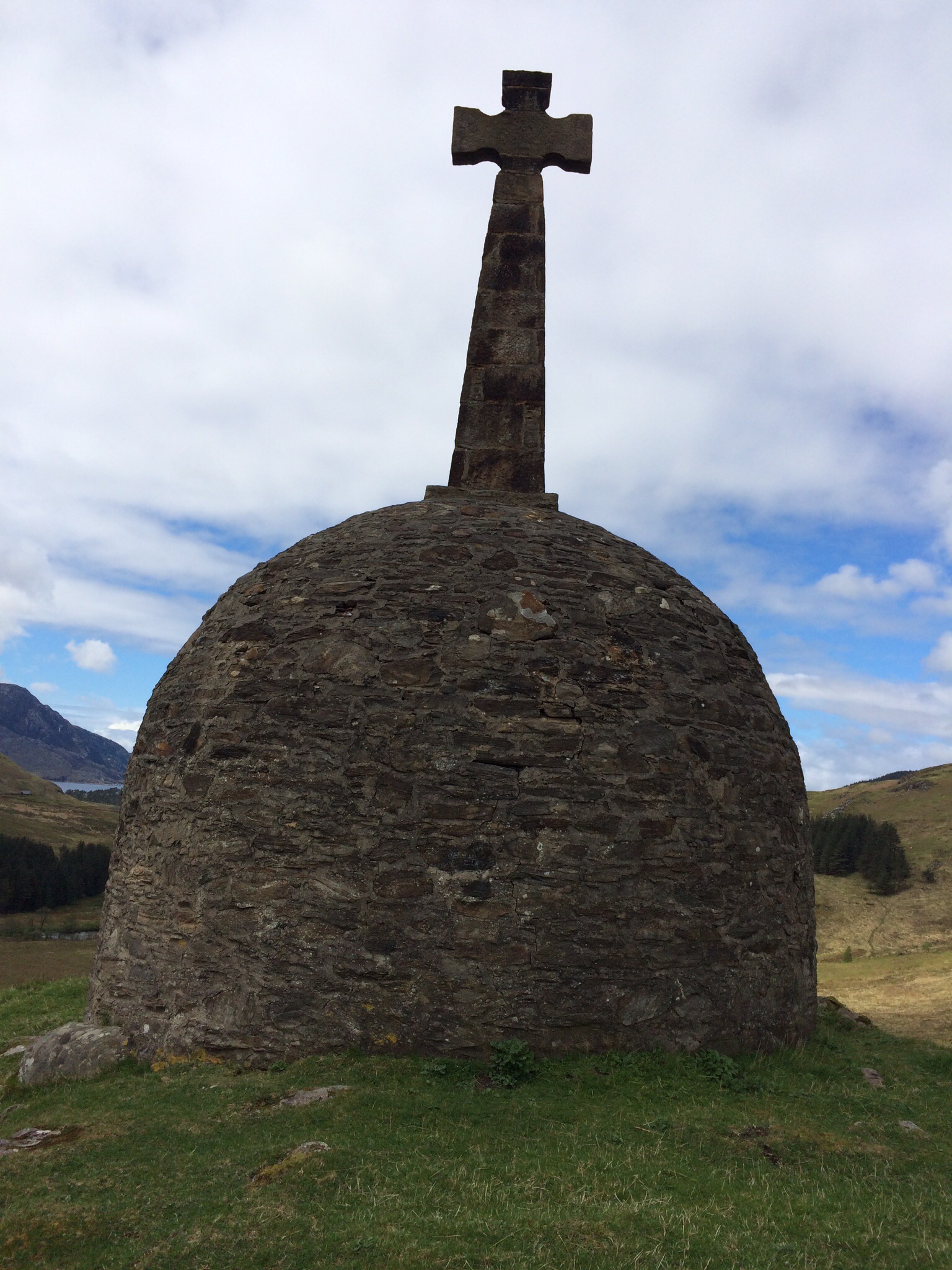
A couple of hours in the two-track trail came around a hill and revealed a huge beehive monument topped with a cross on the top of a hill. It looked to me like it might be a church, possibly the remains of a monastery or something.

At the foot of it was Stephen, who was waiting for Graham, who was scrambling up the hill around boulders and outcrops to see what it was.

“He thinks it’s a monument to the people sent off in the Clearances,” Stephen said.

Of course I took off my pack–didn’t need much of an excuse–and scrambled up to see for myself. I met Graham as he was coming down. It wasn’t a monument to the victims of the Clearances. It was the monument to an aristocrat, put up in the 1930s, a little late for that outrage, but probably not others.  Graham seemed to have heard of him.

“It’s worth seeing,” he said. “A son put it up for his father, thanking him and saying how great he was. And he was a perfect bastard.”

Hard to know.  I’ve never heard of the guy.  But you can be sure that his son didn’t carry the stones up the knoll himself.

By the time I got down, taking the less-steep opposite side, Graham and Stephen had gone and the road was empty.

« Older posts Newer posts »

© 2026 A wee walk

Theme by Anders NorenUp ↑